Market Watch
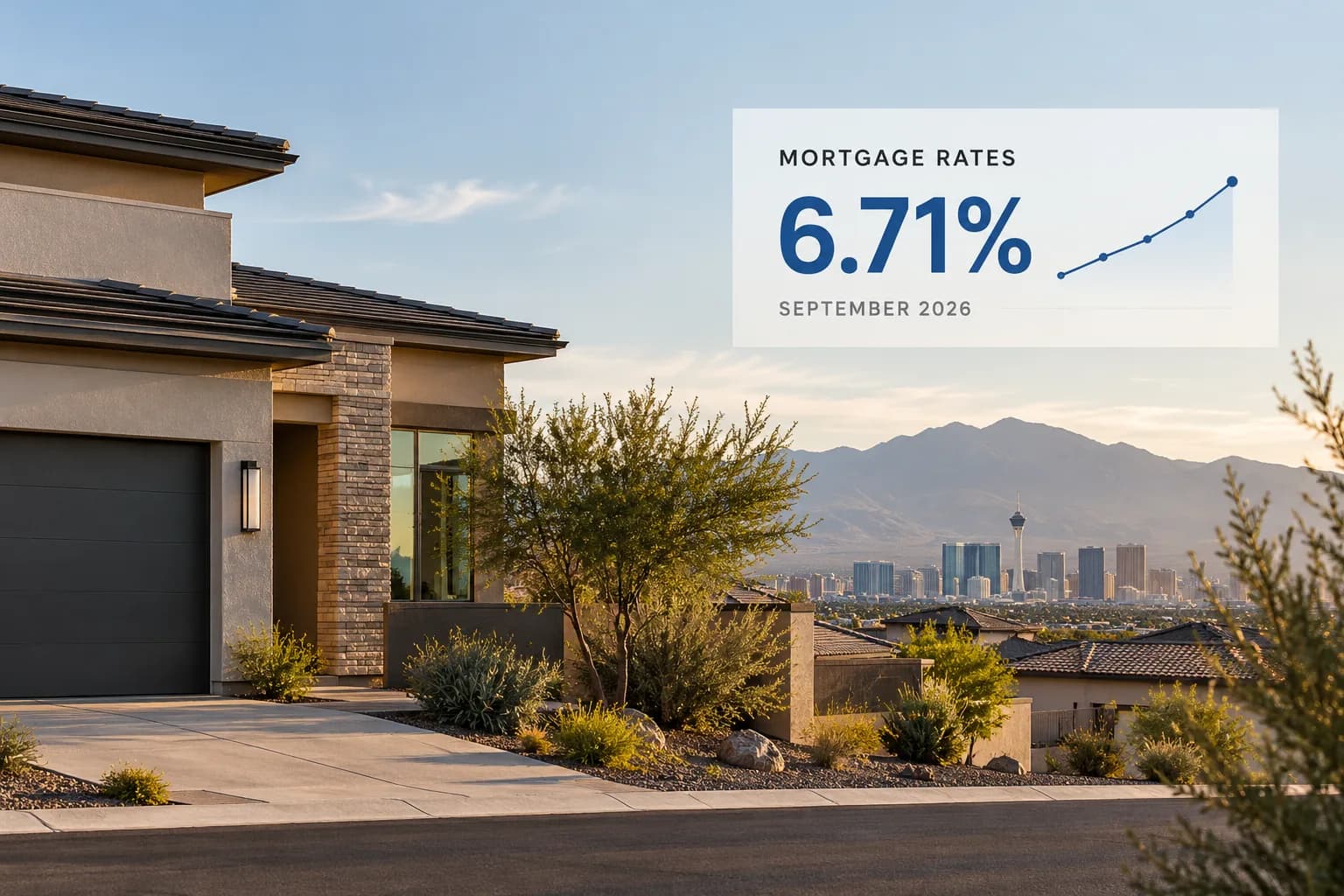
Freddie Mac's weekly survey put the average 30-year fixed mortgage rate at 6.71% for the week of September 3, 2026 — up from 6.66% the week before, and the highest that average has been in 13 months. If you've been sitting on the sidelines waiting for rates to ease, this week's print moved in the wrong direction. Here's what that actually does to a Las Vegas buyer's math, and why it isn't the whole story.
The last time the 30-year average was this high was July 31, 2025, at 6.72%. The 15-year average moved the same direction, to 6.04% from 5.98%. Both numbers are still below where they sat during the highest points of the last few years, but the direction, not just the level, is what’s worth paying attention to right now.
What actually happened this week
Freddie Mac’s Primary Mortgage Market Survey (PMMS) is the benchmark most of the industry quotes when it says “mortgage rates.” It’s a national weekly average, not a Las Vegas number specifically — there’s no separate Las Vegas mortgage rate; local buyers borrow against the same national market everyone else does, with their own rate then set by their credit, down payment, loan type, and lender.
This week’s release: the 30-year fixed averaged 6.71%, up from 6.66% the prior week. The 15-year fixed averaged 6.04%, up from 5.98%. Both are up from a year earlier too — 6.50% and 5.60%, respectively, in September 2025. Freddie Mac’s own release doesn’t frame this as a milestone; it just states the number. The “13-month high” framing comes from wire-service coverage of the same release, which independently traced the last time the 30-year average was this high back to July 31, 2025.
The rate move, by the numbers
Freddie Mac’s weekly national average, alongside the most recent verified Las Vegas price figure for context. Sources at the end of this article.
- Average 30-year fixed rate
- 6.71%
- Average 15-year fixed rate
- 6.04%
- How long since the 30-year was this high
- 13 months
- Las Vegas single-family median
- $480,000
Week of Sept 3, 2026, up from 6.66% · Freddie Mac PMMS
Week of Sept 3, 2026, up from 5.98% · Freddie Mac PMMS
Last seen July 31, 2025, at 6.72% · wire coverage of the same release
July 2026, most recent verified LVR figure
Data reflects the reporting periods cited and changes weekly. See the sources at the end of this article for the full research.
What a rate move like this actually does to a payment
Rates get discussed in headlines as a single number, but what actually matters to a buyer is the payment. Here’s a hypothetical example, not a real transaction: a $480,000 loan — the size of LVR’s most recently verified Las Vegas single-family median, not a specific home or buyer — run at two different 30-year rates from this year’s survey.
| Rate (30-year fixed) | Principal & interest, monthly | On a $480,000 loan |
|---|---|---|
| 6.50% | $3,034 | September 2025’s average |
| 6.71% | $3,101 | This week’s average |
That’s roughly $67 more a month, or about $800 a year, in principal and interest alone on the same loan amount — before property taxes, homeowners insurance, HOA dues, or mortgage insurance, none of which are included in this figure. It’s not a dramatic swing on its own. It’s also not nothing, especially stacked against a year of similar moves — the real effect of higher rates shows up less in any single week and more in how much loan a given monthly budget can actually support.
Purchase demand has remained relatively stable indicating steady interest from buyers adapting to evolving market conditions.
Sam Khater, Freddie Mac Chief Economist
The part rate headlines usually leave out: the Las Vegas market itself has shifted too
A rate story lands differently depending on the market underneath it. LVR’s most recently verified report — July 2026, the most current available as of this piece; an August report had not yet been published — showed the Las Vegas single-family median at $480,000, down 2% from the record set in May and June, with more single-family homes sitting without offers than a year earlier and supply running near four months. That’s not a market in freefall — LVR President George Kypreos described demand as steady in that same report — but it is a market with meaningfully more room to negotiate than the tightest points of the last few years.
Put those two facts next to each other and the honest read isn’t simply “rates up, bad time to buy.” It’s that the math changed on both sides at once: borrowing costs a little more this week than they did last week, in a market that’s already giving buyers more negotiating leverage on price, seller concessions, and closing costs than it has in a while. Whether that nets out better or worse for a specific buyer depends entirely on their own number, not on the rate headline alone.
What this actually changes for someone shopping right now
- A locked rate matters more than a survey average. Freddie Mac’s number is a national weekly benchmark — what a specific lender quotes a specific buyer depends on credit score, down payment, loan type, and points paid, and can land meaningfully above or below 6.71%.
- More inventory and softer prices give buyers leverage that didn’t exist a few years ago — a seller-paid rate buydown or closing-cost credit can offset a rate move like this one more directly than waiting for rates to drop on their own.
- If the rate is the obstacle rather than the price, a larger down payment or a down-payment-assistance program changes the loan amount the rate applies to, which is worth running alongside any rate-buydown conversation with a lender.
- This piece makes no prediction about where rates go from here. Freddie Mac’s own release doesn’t forecast, and neither does this article — plan around what a rate does to your payment today, not a guess about next month.
Update: the climb didn’t stop here. Read what happened to rates over the following two weeks — including the day faster-moving daily trackers put the 30-year fixed right at 7%.
Mikey's local take
The number I’d actually sit with here isn’t 6.71% — it’s $67 a month on a $480,000 loan. That’s a real cost, but it’s a manageable one, and it’s smaller than what a decent seller concession or rate buydown can offset in the current market. The bigger mistake I see buyers make isn’t buying at 6.71% instead of 6.50%. It’s waiting on the sidelines for a rate that may or may not show up, in a market that’s already giving them more room on price and terms than it has in years.
If you’re trying to figure out whether this week’s rate actually changes your plan, run your real number instead of the headline one. See what a starter-tier budget or a $500K budget actually gets you today, then look at what’s actually on the market at that number.
Sources
- Freddie Mac, Primary Mortgage Market Survey (PMMS), week of September 3, 2026. The source for the 30-year and 15-year rate figures, the week-over-week and year-over-year comparisons, and the quote from Chief Economist Sam Khater. Directly fetched from freddiemac.com/pmms and cross-checked against the official release on GlobeNewswire.
- Wire-service coverage of the same release — the source for the “13-month high” framing and the July 31, 2025 (6.72%) reference point, independently reported by Yahoo Finance, WTOP, and KSAT.
- Las Vegas Realtors (LVR). Official July 2026 housing report — the source for the $480,000 valley-wide single-family median, the inventory and days-on-market figures, and the quote from LVR President George Kypreos cited for local context. Full detail and sourcing in our July 2026 resale coverage. An LVR report for August 2026 had not been published as of this article; no August figure is asserted anywhere above.
Mortgage rates and market conditions change weekly and can move again before you read this. The payment example above is a hypothetical illustration of principal and interest only — it excludes taxes, insurance, HOA dues, and mortgage insurance, and is not a quote. This article is general market commentary, not financial, lending, tax, or investment advice.
About this coverage
Mikey Del Rosario · Las Vegas Real Estate Advisor · The Scofield Group · Nevada License S.0175577. Equal Housing Opportunity.