Comparisons
Henderson and Southwest Las Vegas both come up constantly when someone tells me they want new construction and a settled place to land, and people rarely weigh them against each other on purpose. They fall into one or the other because a listing caught their eye or a friend already lives there. That's a shame, because the two are closer to each other than either is to Summerlin, and the real difference between them isn't vibe. It's structure.
Full disclosure up front, same as always: I’m not handing you a score and a winner. What I can do is walk through the real differences (read the full Henderson guide and the full Southwest guide for the long version of each) and let you match them to your own life instead of mine.
Which area fits you best?
I put this same question on camera, with Summerlin thrown into the mix too, if you'd rather watch it than read it.
A city that answers to you vs. a name everyone uses
Start with the one fact that actually decides everything else. Henderson is an incorporated city, Nevada’s second largest, with its own mayor, council, police and fire departments and its own parks department and zoning. When something goes wrong with a road, a permit or a code question inside the city limits, you call Henderson. It has a real, surveyed boundary you can look up.
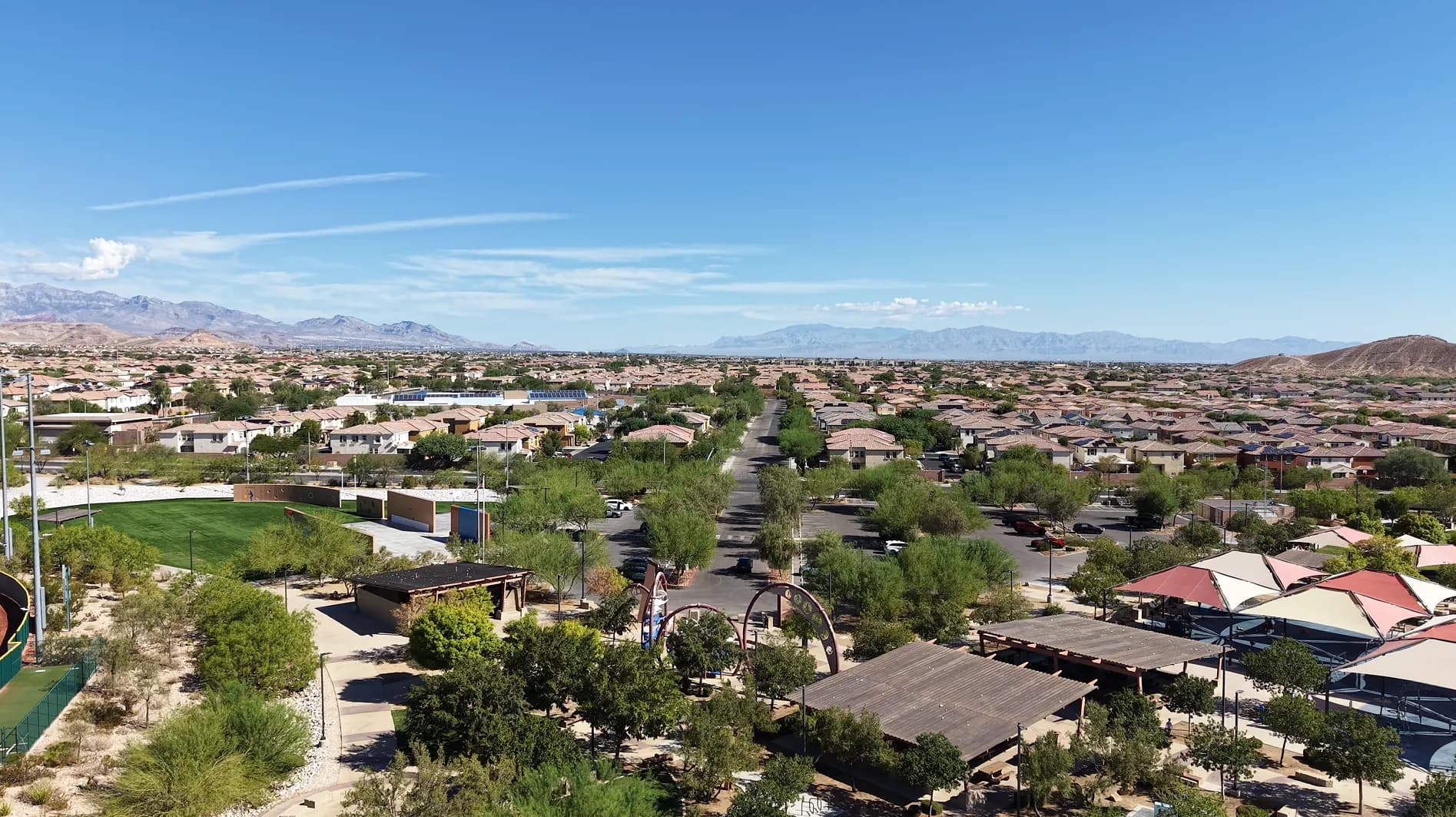
“Southwest Las Vegas” isn’t a place any government recognizes. There is no city limit, no legal boundary, and no line on a county map that says where it starts and stops. It’s shorthand locals and agents use loosely for a stretch of overwhelmingly unincorporated Clark County (mainly the towns of Enterprise and Spring Valley), filled in by many separate builders rather than planned as one thing. Two people using the term can mean two different chunks of the valley, and nobody is going to correct you, because there’s nothing to correct you against.
That’s the real distinction: in Henderson you’re a resident of a city that answers to you. In most of the Southwest you’re a resident of Clark County, and “Southwest” describes a general direction, not a jurisdiction. If knowing exactly who governs your address and what the rules are matters to you, Henderson can answer that in a way the Southwest genuinely can’t.
Location, and why neither guide will hand you a drive time
Both full guides refuse to publish a single commute figure for their area, and for the same underlying reason: both areas are too large and too varied for one number to mean anything. Henderson spans about seventeen miles east to west, so a Green Valley address and a Lake Las Vegas address don’t drive the same trip. The Southwest has no boundary at all, so a home off Blue Diamond and a home at Durango and the 215 aren’t the same trip either. If a page hands you minutes, be suspicious of it. This one isn’t going to.
What is fair to say: the Southwest tends to run closer to the airport and the south Strip from most of its points, with its new construction scattered across infill parcels rather than concentrated the way a master plan concentrates it. Henderson gives you more established housing to choose from and, in West Henderson, an employment corridor the Southwest doesn’t have an equivalent of. The two genuinely overlap geographically around St. Rose Parkway, which is why buyers so often end up cross-shopping both without realizing they’ve crossed a city line. The 215 beltway is the reason either side works at all: it’s the spine the Southwest hangs off, and it’s also the road that connects Henderson north toward Summerlin and the Southwest and east toward the airport.
One has a mayor. The other has a name everyone uses and no one can define.
Housing stock and community character
Henderson’s housing stock spans a genuinely wide range, because the city is a jurisdiction, not a product: the established, mature-tree-canopy resale of Green Valley; brand-new construction in Inspirada and Cadence; guard-gated custom hillside estates at MacDonald Highlands and Ascaya; a resort lake community at Lake Las Vegas; and a historic downtown at Water Street that predates all of it. That range exists because Henderson has had decades, and several different developers, to fill it in.
The Southwest’s dominant product is a newer single-family home, often behind a gate, built by one builder over a short window — but the range around that is wider than the reputation suggests. Inside a master plan (Mountain’s Edge, Southern Highlands, Rhodes Ranch) you get the coordinated consistency Henderson’s newer communities also offer. Outside one, in stretches like Nevada Trails and central Enterprise, you get whatever each builder did on each parcel: more variety, sometimes more house for the money, with a lot less of a plan holding it together. Both resale and new build are genuinely available in both places, which isn’t true everywhere in the valley.
Neither guide publishes an average price for its area, and for the same reason: Henderson’s range (age-restricted condos to hillside homesites) makes a single median meaningless, and the Southwest has no agreed boundary to calculate one against in the first place. If a page hands you a submarket median for either area, that’s worth asking where the line was drawn.
Who each one actually suits
Henderson suits people who want to compare genuinely different housing environments without leaving one city: established and grown-in against brand-new, valley floor against hillside, master plan against old main street. It also suits anyone whose life is anchored on the south or east side of the valley, who wants to be near the airport or the south Strip, who wants mature landscaping without needing a new build, or who specifically wants elevation and a long view and is willing to drive for it.
The Southwest suits people for whom a newer home matters more than an established one, who are relaxed about driving everywhere (the area was planned around driveways, not sidewalks), and who’d rather have more house than more character or a walkable center. Its new construction and beltway access make it a reasonable answer for the same broad relocation profile Henderson often gets recommended to, just with newer streets and less institutional history behind them.
Neither is the fit if you want a genuinely walkable, historic center: Henderson has one small pocket of that at Water Street and The District at Green Valley Ranch; the Southwest has one at UnCommons and The Bend, and both are described on their own guides as pockets, not properties of the whole place.
Where each one falls short
Neither of these is the right move for everyone, and I’d rather tell you that now than after you’ve signed. Henderson’s honest downside is the flip side of its biggest strength: the range that makes it flexible also makes “Henderson” a genuinely confusing answer until you’ve picked a corner, some of that corner (the southern hillsides, Lake Las Vegas) adds real driving time to everything, and two major road projects (Boulder Highway through 2027, I-215 widening through 2028) are dug into the city right now.
The Southwest’s honest downsides: there’s no legal boundary to hold anyone accountable to, which also means no defensible submarket data exists for it; HOA structure and housing age vary enormously street to street, with no such thing as “the Southwest HOA situation”; and it is, honestly, still being built — unfinished parcels, a sidewalk that stops, a beautiful street that ends at a wall. None of that is decline, but if half-built horizons and years of nearby construction would wear on you, it’s worth knowing going in, the same way Henderson’s growth areas (Inspirada, Cadence, West Henderson) come with their own construction-adjacent years.
So, which one actually wins?
Neither, and that’s a real answer, not a dodge. If you want the option to compare genuinely different kinds of housing inside one jurisdiction, with an actual city government behind your address, Henderson gives you room the Southwest doesn’t have. If you want newer construction, don’t mind driving, and would rather not pay for decades of institutional history you won’t use, the Southwest is very hard to beat on that specific trade.
The question worth answering isn’t which one is objectively better. It’s whether you want a place with a government behind it or a place that’s still being written, and which side of St. Rose Parkway your actual daily life points toward. For that, the honest next step is usually a conversation, not another list. Tell me your budget, your commute, and what a good Tuesday looks like to you, and I’ll tell you straight which side of the valley actually fits.
About this coverage
Mikey Del Rosario · Las Vegas Real Estate Advisor · The Scofield Group · Nevada License S.0175577. Equal Housing Opportunity.